Cut & Folded Flight Pitch Screw Conveyors
Enhanced Mixing and Conveying Solutions
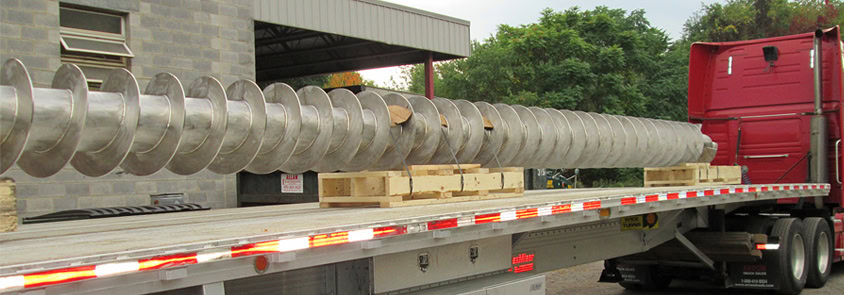
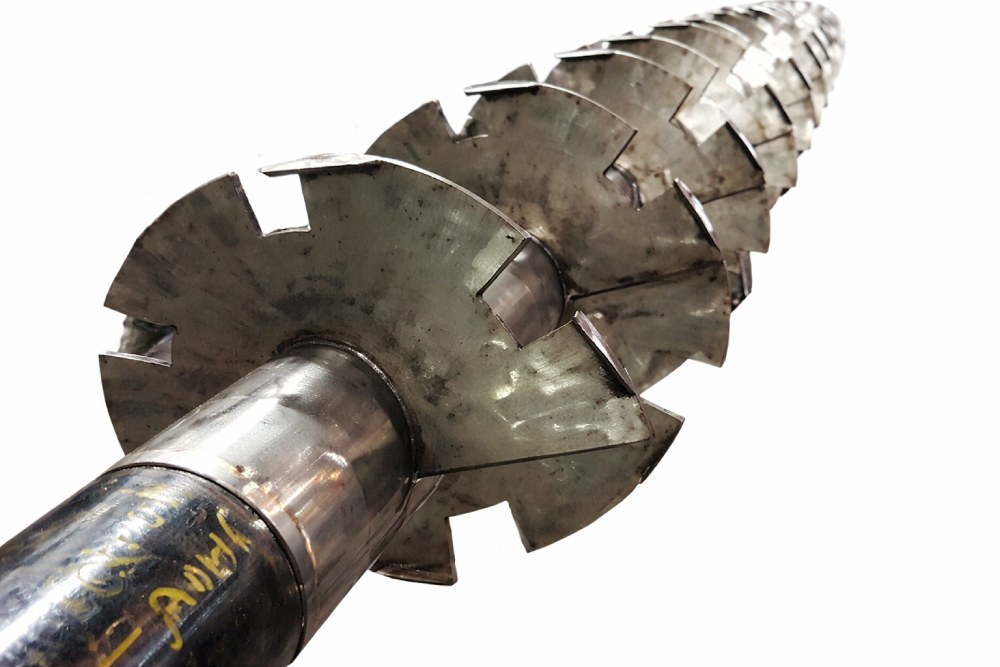
A cut and folded flight pitch screw conveyor is a specialized type of screw conveyor designed to provide both material transport and enhanced mixing, lifting, and breaking up of materials. This is achieved by notching and bending the outer edge of each flight into small tabs, which act as built-in paddles. This design offers a significant advantage over standard continuous helical blades, which are primarily used for straight conveying.
Understanding Cut & Folded Flights
To clarify the distinction, consider the following definitions:
- Standard Screw Flight: A continuous helical blade with a smooth outer edge, primarily utilized for straightforward material conveyance.
- Cut Flight: Features rectangular notches cut into the outer edge of the flight. These interruptions promote some degree of mixing, agitation, and lump breaking within the material flow.
- Cut and Folded Flight: Builds upon the cut flight design by bending the notched edges upwards, typically at a 90-degree angle. These bent tabs create small arms that actively scoop and tumble the material, resulting in much more aggressive mixing and agitation compared to cut flights alone. These are commonly built on a standard pitch screw, often referred to as “standard pitch, single cut and folded flight” screws.
Typical Uses by Industry and Application
Cut and folded flight screws are selected when significant mixing, agitation, or particle breakup is required concurrently with material conveyance. Key applications across various industries include:
- Breaking up brittle or friable cakes or agglomerates: For instance, expeller or ExPress® cake being transferred to a cooler, ensuring uniform cooling and preventing clumping.
- Mixing additives or coatings: Integrating ingredients into granular or pelleted products during transfer, ensuring consistent product composition.
- Conditioning and homogenizing powders or granules: Preparing materials as they move between different process steps, ensuring uniform consistency for subsequent operations.
- Improving dispersion of small dosed ingredients: Effectively distributing colorants, catalysts, or other minor components into a base resin or powder, enhancing product quality.
- Breaking up crusted, partially set, or lumpy material: Preventing “plug flow” and ensuring smooth material handling.
- Providing some mixing: Offering a cost-effective mixing solution where a full-scale blender is not justified.
- Shredding or de-lumping fibrous, flaky, or partially dried material: Effectively processing materials such as manure solids, fiber, or sludge cake during conveyance.
In essence, cut and folded flights are employed whenever the conveyor needs to actively mix, lift, or de-lump material, rather than merely transporting it.
James Eagen Sons Co. possesses extensive experience in constructing various flight types, including cut, notched, ribbon, and folded-flight screws, for a diverse range of industries. This cross-industry expertise allows us to apply valuable lessons to each unique application.
Key Design Considerations
When specifying a screw for a project, the following factors are crucial in determining the suitability of cut and folded flighting and its optimal design:
- Material Behavior and Goal: Free-flowing, brittle, or lightly cohesive materials requiring aeration, de-lumping, or light mixing are ideal candidates. Conversely, very sticky or smeary materials typically necessitate ribbon or specialized self-cleaning configurations.
- Degree of Cutting and Folding: The notch size, spacing, pattern, and the extent to which the tabs are folded up directly influence the aggressiveness of the screw’s agitation, lifting, and shearing action on the product. More aggressive geometries enhance mixing and de-lumping but can reduce capacity, increase horsepower, and potentially damage fragile products.
- Capacity, Horsepower, and Wear: Due to flow interruption, a cut and folded screw will generally move less volume and require more power than an equivalent plain flight screw. This must be factored into drive sizing. In abrasive environments, thicker sectional flights and wear-resistant alloys are essential to protect the concentrated impact points of the folded edges.
- Sanitation, Cleanout, and Access: In food and sanitary applications, the additional edges and corners demand careful attention to cleanability, provisions for Clean-In-Place/Sterilize-In-Place (CIP/SIP), and inspection access. Features like removable covers, cleanout doors, and appropriate finishes are vital to minimize downtime and prevent contamination.
James Eagen Sons Co. provides expert guidance through these trade-offs, ensuring the selection of the optimal combination of flight style, pitch, and materials. Let us eliminate the guesswork.
Is it Sectional or Helicoid?
The term “cut and folded flight” describes the specific flight edge pattern, not the manufacturing method of the underlying flight. The primary categories of flight manufacturing are:
- Helicoid Flight: Produced by cold-rolling strip steel into a continuous helix, which is then welded to the pipe. This method is common, cost-effective, and suitable for many standard-duty applications.
- Sectional Flight:** Each flight segment is individually cut from a plate and formed, then butt-welded onto the pipe. This allows for heavier thicknesses and specialized geometries, ideal for abrasive or custom applications.
Manufacturers apply the “cut” and “cut and folded” features to both helicoid and sectional flights through machining or notching and forming the outer edge after the initial flight formation.
Comparison to Ribbon and Blender Screws
A cut and folded flight screw offers more mixing and de-lumping capabilities than a standard screw, positioning it as an intermediate solution between simple conveying and the intensive mixing provided by full ribbon or blender screws.
Cut & Folded Flight Screw vs. Ribbon Screws
- Ribbon Screws: Characterized by an open center, making them ideal for sticky, viscous, or caking materials (e.g., sludges, adhesives, high-moisture mixes) that tend to pack around a solid shaft.
- Cut and Folded Screws: Maintain a solid web, but the cut and upturned tabs disrupt flow and tumble material. They are more effective for aeration, de-lumping, and moderate mixing of free-flowing or friable materials, rather than highly sticky products.
Cut & Folded Flight Screw vs. Blender Screws
- Blender Screws: Often feature ribbon or multiple flights within a trough mixer, specifically designed for intensive, uniform blending, frequently operating in batch or recirculating modes.
- Cut and Folded Screws: Primarily function as conveyors that also provide mixing. They offer greater agitation than plain or cut flights but provide less residence time and uniformity compared to dedicated ribbon or paddle blenders, with the advantages of lower cost and simpler layout.
Choose cut and folded when a single piece of equipment is needed to convey, break lumps, and provide some mixing or aeration. Choose ribbon/blender when the primary objective is complete, homogeneous mixing of sticky or complex blends, and conveying is a secondary consideration.
Benefits of Working with James Eagen Sons Co.
The true value of cut and folded flight screws is realized when the right design is paired with a manufacturer possessing the expertise to execute it flawlessly:
- Deep Experience and Broad Capabilities: Established in 1875, James Eagen Sons Co. has over a century of dedicated experience in screw conveyors, flights, ribbon screws, and blenders. This provides customers with a partner who has encountered and resolved most material-handling challenges previously.
- Application-Driven Engineering: Our team assists clients in determining whether a cut and folded conveyor, a ribbon/blender configuration, or a hybrid design is the most suitable solution for their material, capacity, and process constraints. This minimizes trial-and-error in the field.
- Customization and Lifecycle Support: James Eagen Sons Co. routinely produces custom feedscrews, mixers, and replacement flights (including notched and folded designs), allowing customers to seamlessly match new screws to existing equipment or upgrade performance without re-engineering entire production lines.