Tapered Flight & Tapered Shaft Feedscrews
When Consistent Flow is Mandatory
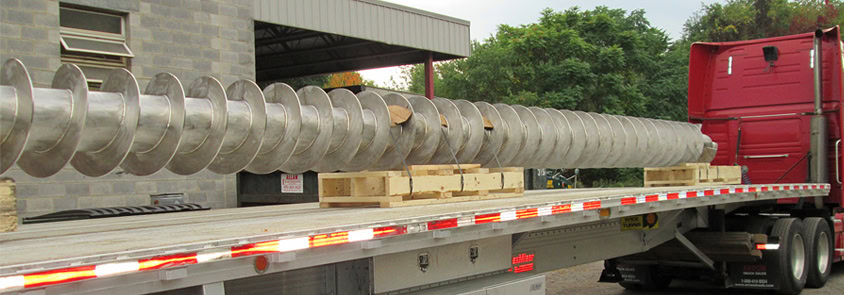
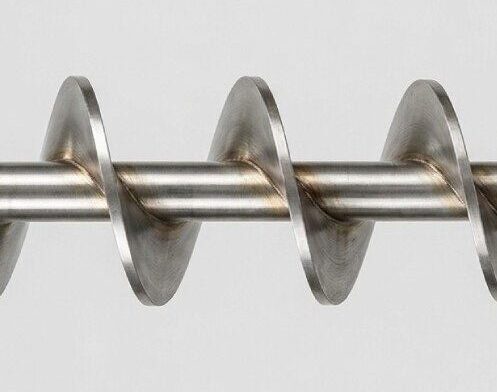
Tapered flight and tapered shaft feedscrews are specialized screw conveyor designs engineered to provide controlled material drawdown and volumetric consistency. Unlike standard screws that pull material primarily from the back of an inlet, tapered designs vary the available volume within the screw envelope. This ensures that material is drawn evenly across the entire length of a hopper or bin opening, preventing “dead zones,” ratholing, and bridging.
Understanding Tapered Geometries
To clarify the mechanical distinction, consider the following definitions:
- Standard Screw Flight: Maintains a constant outer diameter and a constant center pipe diameter. While excellent for transport, it lacks the volumetric graduation needed for uniform bin unloading.
- Tapered Flight (O.D. Taper): The outer diameter of the flight increases gradually from the rear of the inlet toward the discharge. This allows the screw to “pick up” additional material as it moves forward, creating a uniform draw across the hopper length.
- Tapered Shaft (I.D. Taper): The center pipe or shaft starts with a large diameter and tapers down to a smaller diameter. This increases the “pocket” space between the flights as the material moves forward, achieving a similar uniform drawdown effect while maintaining a constant outer diameter to fit standard troughs.
Typical Uses by Industry and Application
Tapered screws are commonly used for “Live Bottom” bins and feeders where consistent flow is mandatory.
- Uniform Bin Discharge: Ensuring first-in, first-out (FIFO) flow of grains, flour, or meal from large rectangular surge bins.
- Conditioning Dry Ingredients: Providing a steady, non-pulsing feed to extruders or mixers where density fluctuations would compromise product quality.
- Compaction and De-aeration: Used to compress aerated powders, removing air and increasing material density before it reaches a bagging or processing station.
- Precision Dosing: Delivering a highly consistent volume of resin pellets or chemical additives to downstream equipment.
- Managing Heavy “Head Loads”: Tapered shafts are exceptionally robust, allowing the screw to start under the massive weight of a full mineral bin without seizing or bending.
- Handling Cohesive Solids: Moving shredded wood, paper pulp, or sludge. The tapered design prevents the material from “packing” or bridging at the inlet, which is a common failure point in standard screws.
- Live Bottom Unloaders: Utilizing multiple tapered screws side-by-side to empty massive silos of biomass or municipal waste evenly.
Key Design Considerations
Specifying a tapered screw requires careful calculation of the “expansion ratio” to match the hopper dimensions:
- Volumetric Graduation: The rate of the taper must be precisely calculated. If the taper is too shallow, the screw will still pull predominantly from the rear; if too steep, it can cause material compression and high torque requirements.
- Trough Clearance: For tapered flight (O.D.) designs, the trough must often be custom-fabricated to match the tapering profile of the screw, whereas tapered shaft (I.D.) designs can usually fit in standard U-troughs.
- Horsepower and Startup Torque: Because these screws are often “submerged” under a full bin of material (head load), they require significantly higher startup torque than standard conveyors.
- Structural Integrity: Tapered shafts often require custom-machined stepped pipes or specialized conical sections to maintain structural rigidity under load.work.
Is it Sectional or Helicoid?
Manufacturing tapered geometries is a high-precision task that usually dictates the flight type:
- Sectional Flight: Highly Recommended. Each segment is individually cut and formed to a specific inner or outer diameter. This is the only way to achieve a precise, incremental taper across a long distance. James Eagen Sons Co. specializes in these custom-profile sectional flights.
- Helicoid Flight: Generally not suitable for tapered applications. The cold-rolling process used for helicoid flighting is designed for constant diameters; attempting to taper helicoid flighting often results in material thinning and structural weakness.
Comparison to Variable Pitch and Standard Screws
Versus Variable Pitch
- Variable Pitch: Achieves uniform draw by increasing the distance between flights.
- Tapered Designs: Achieve uniform draw by increasing the depth of the flight.
- The Hybrid: In many demanding applications, James Eagen Sons Co. combines both—a tapered shaft with a variable pitch—to provide the ultimate solution for difficult-to-handle materials.
Versus Standard Screws
A standard screw is a “transporter.” A tapered screw is a “meter.” If your process depends on a constant, predictable flow from a storage bin, a standard screw is likely inadequate.n.
Benefits of Working with James Eagen Sons Co.
The true value of a tapered feedscrew lies in the engineering behind the taper. James Eagen Sons Co. provides the expertise needed to execute these complex geometries:
- Precision Profiling: We calculate the exact taper required to ensure your bin empties evenly, preventing spoilage and ratholing.
- Heavy-Duty Fabrication: Our sectional flighting capabilities allow us to build tapered screws with thick, wear-resistant materials that can handle extreme head loads.
- Custom Solutions: We routinely produce custom-machined tapered shafts and flights for the most demanding food, chemical, and mineral applications, ensuring a seamless fit with your existing equipment.