Paddle Mixer Screw Conveyors
For High-Intensity Agitation or Uniform Blending of Multiple Ingredients
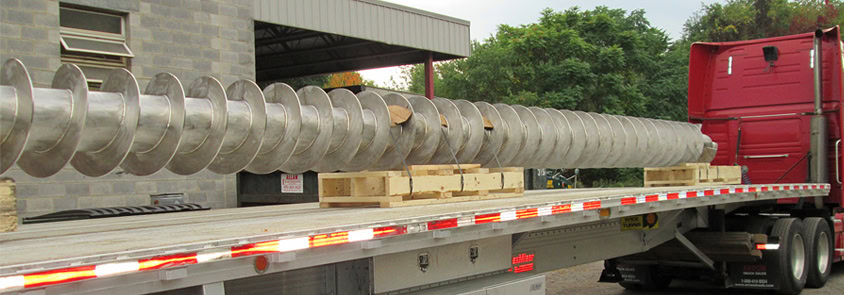
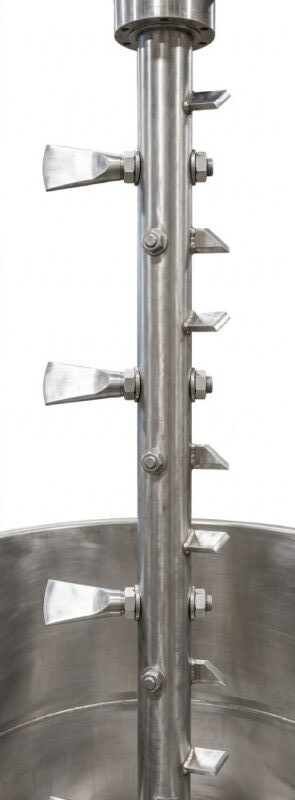
A paddle mixer screw conveyor is a specialized material handling solution designed for applications where intensive mixing, stirring, and blending are just as important as material transport. Constructed from steel, the paddle mixer ensures robust material flow during high-intensity agitation. This is achieved by replacing or augmenting continuous helical flights with a series of individual, adjustable blades (paddles) mounted on a center shaft. This design offers a significant advantage over standard continuous helical blades, which are primarily used for straightforward conveying and lack the “tumble and turn” action required for thorough blending.
Understanding Paddle Flighting
To clarify the mechanical distinction, consider the following definitions:
- Standard Screw Flight: A continuous helical blade with a smooth outer edge, primarily utilized for linear material conveyance with minimal agitation.
- Cut and Folded Flight: A hybrid design that notches and bends the edge of a continuous flight to create some mixing action while maintaining a solid web.
- Paddle Mixer: Features individual blades (paddles) fixed to the shaft. These paddles are typically pitched to provide both forward movement and aggressive radial mixing. Because they are individual units, they allow material to pass through the gaps, increasing residence time and ensuring every particle is agitated.
Key Design Considerations
- Adjustable Pitch: Most paddles are mounted so they can be rotated on their stems. This allows operators to “tune” the mixer—angling them forward for more speed, or flat to increase mixing time (residence time).
- Residence Time: Because paddles do not have a continuous web, they are less efficient “movers” than standard screws. This is intentional; it keeps the material in the mixer longer to ensure a complete blend.
- High Torque and Horsepower: Moving material with paddles creates significant resistance. Drive systems must be sized to handle the higher torque required to “shovelful” the material rather than sliding it.
- Abrasive Wear: In mineral or waste applications, paddles are high-wear items. James Eagen Sons Co. often manufactures these from abrasion-resistant alloys or with hard-faced edges to maximize service life.
Typical Uses by Industry and Application
Paddle mixers are selected when the process demands high-intensity agitation, moisture addition, or the uniform blending of multiple ingredients.
- Adding Liquids to Dry Solids: Effectively blending molasses, fats, or oils into grain and animal feed mashes without clumping.
- Conditioning Steam-flaked Products: Ensuring uniform heat and moisture distribution in grains or cereals as they move toward rolling or flaking stations.
- Dust Conditioning (Ash Unloaders): Adding water to fly ash or cement dust to create a “damp” mix that is easy to transport without becoming airborne.
- Slurry Mixing: Stirring heavy mineral slurries to prevent sedimentation and maintain a homogeneous suspension.
- Coating Granules: Uniformly applying liquid colorants, catalysts, or stabilizers to plastic resin pellets or chemical powders.
- Cooling or Heating Solids: Maximizing material contact with the trough surface or heated shaft to improve thermal transfer efficiency during transport.
- Sludge Stabilization: Mixing lime or other stabilizing agents into municipal sludge or industrial waste to neutralize odors and pathogens.
- Compost Aeration: Tumbling organic matter to ensure oxygen reaches the center of the material stream, accelerating the decomposition process.
Is it Sectional or Helicoid?
While “paddle” refers to the individual blade, the manufacturing of the shaft and assembly is a custom engineering task:
- Sectional Components: Paddles are typically manufactured using sectional methods—either cut from heavy plate or forged. This allows for much greater thicknesses and more robust attachment methods than thin cold-rolled helicoids.
- Hybrid Designs: In some cases, James Eagen Sons Co. builds “Screw-Paddle” combinations, where a sectional flight handles the initial intake, and paddles perform the mixing in the center of the run.
Comparison of Paddle Mixers to Ribbon and Standard Screws
Paddle Mixers Versus Ribbon Screws
- Ribbon Screws: Excellent for sticky materials that would clog a shaft.
- Paddle Mixers: Better for blending multiple components together or adding liquids to solids, as the individual blades provide more “cutting” and lifting action than a ribbon.
Versus Standard Screws
- Standard Screws: Move material efficiently but often result in “stratification” where different sized particles separate.
- Paddle Mixers: Force materials of different densities and sizes to stay integrated through constant tumbling.
Benefits of Working with James Eagen Sons Co.
The effectiveness of a paddle mixer depends entirely on the orientation and spacing of the blades. James Eagen Sons Co. offers:
- Deep Application Expertise: Since 1875, we have provided mixing solutions for the world’s most demanding industries. We know the “angle of attack” needed for your specific material.
- Customization: We produce a wide range of paddle styles, including standard, forward-reverse, and notched, to match your specific process constraints.
- Lifecycle Support: We provide high-quality replacement paddles and shafts that are balanced and ready to install, minimizing downtime during maintenance cycles.