Long Pitch Feedscrews
High-Capacity Transport and Rapid Material Handling
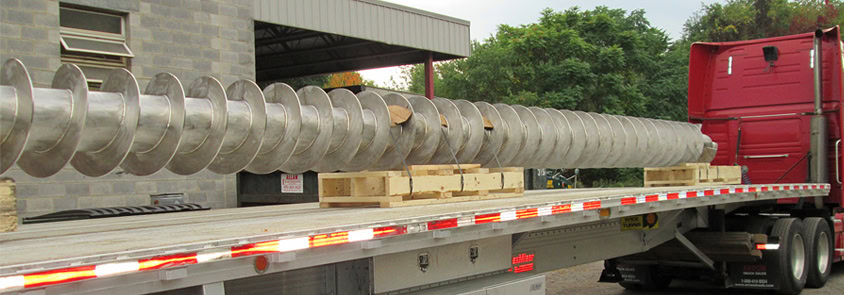
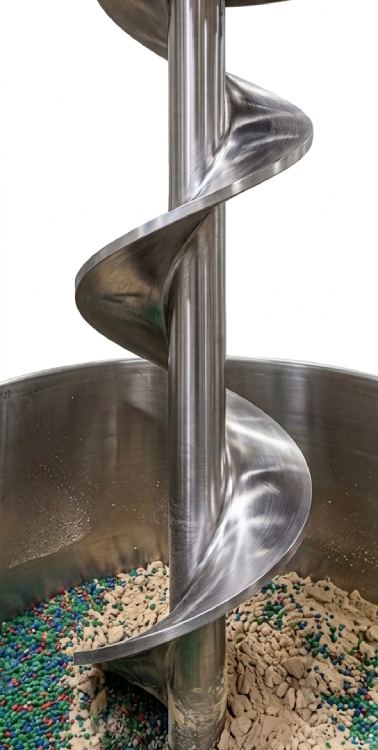
A long pitch screw conveyor (also known as an extended pitch screw) is a specialized type of screw conveyor where the distance between flights is significantly greater than the screw’s diameter. While standard pitch screws are balanced for general transport, long pitch screws are engineered for maximum throughput and rapid material movement. By creating larger internal pockets between the flights, this design offers a significant advantage when handling fluid-like materials or when high-volume conveyance is required in a short amount of time.
Understanding Pitch Variations
To clarify the distinction, consider the following definitions:
- Standard Pitch Screw: A continuous helical blade where the pitch (distance between flights) is approximately equal to the screw diameter (e.g., a 10″ pitch for a 10″ screw).
- Short Pitch Screw: Features a pitch shorter than the diameter (often 1/2 or 2/3 pitch). It is primarily used for inclines and metering to prevent material fallback.
- Long Pitch Screw: Features a pitch that is 1.5 to 2 times the diameter (or more). This “stretched” helix moves material much faster per revolution than standard designs, making it ideal for free-flowing materials that do not require agitation.
Key Design Considerations
When specifying a long pitch screw, the following factors are crucial to ensure efficiency and safety:
- Flow Velocity: Because the material moves further per revolution, it travels at a much higher linear velocity. This can lead to increased impact at discharge points.
- Horsepower Requirements: While long pitch screws move more material, they often require less torque per ton than short pitch screws in horizontal applications. However, they are not suitable for steep inclines, as the material will tumble backward over the “stretched” flights.
- Material Behavior: This design is strictly for free-flowing materials. Sticky, cohesive, or “smeary” materials will fail in a long pitch screw as they cannot be effectively pushed forward by the shallow angle of the flighting.
- Screw Deflection: Because there are fewer flights supporting the weight of the material per linear foot, the center pipe must be carefully sized to prevent sagging, especially in long spans.
Typical Uses by Industry and Application
Long pitch screws are selected when the primary goal is high-speed transport of free-flowing, non-abrasive materials. Key applications include:
-
Rapid Silo Discharge: Moving large volumes of grains, seeds, or dry pellets from storage to processing lines quickly.
- Fluid-like Material Handling: Transporting dry, free-flowing ingredients that behave like liquids, where the increased pitch prevents the material from “piling up” against the flights.
- Pellet Conveying: Moving plastic resin pellets over long horizontal distances with minimal resistance and high efficiency.
- Non-Cohesive Powders: Handling dry, stable chemical powders where rapid transfer is required between stages without the need for mixing or conditioning.
- Lightweight Bulk Solids: Moving materials like perlite, vermiculite, or dry sawdust where the material density is low and high volume is necessary to meet tonnage requirements.
- Agitator/Mixer Discharge: Clearing out a batch mixer quickly once the blending cycle is complete.
- Liquid/Slurry Movement: In specific low-viscosity applications, long pitch screws can move high volumes of liquid or very thin slurries effectively.
Is it Sectional or Helicoid?
“Long pitch” refers to the geometric spacing of the helix, which can be produced via both methods:
- Helicoid Flight: Produced by cold-rolling strip steel into a continuous helix. Achieving a long pitch in helicoid can be efficient for light-to-medium duty applications.
- Sectional Flight: Each flight segment is individually cut and formed. This is the preferred method for heavy-duty long pitch screws, as it allows for thicker flights and specialized alloys that can withstand the higher linear speeds and potential wear.
Comparison to Short and Standard Pitch
| Feature | Short Pitch | Standard Pitch | Long Pitch |
| Primary Goal | Metering/Inclines | General Transport | High Capacity/Speed |
| Pitch Ratio | 0.5 – 0.75 x Dia | 1.0 x Dia | 1.5 – 2.0+ x Dia |
| Incline Suitability | Excellent | Fair | Poor (Horizontal only) |
| Mixing Action | High | Moderate | Very Low |
Benefits of Working with James Eagen Sons Co.
The efficiency of a long pitch screw depends on the precision of the helix. James Eagen Sons Co. brings over 150 years of expertise to every build:
- Precision Geometry: We ensure that the “stretched” helix is uniform throughout the screw, preventing material surging and vibration.
- Custom Fabrication: We routinely produce custom long pitch feedscrews and replacement flights, allowing you to optimize your existing troughs for higher throughput.