Short Pitch Feedscrews
Precision Volumetric Feeding and Control Solutions
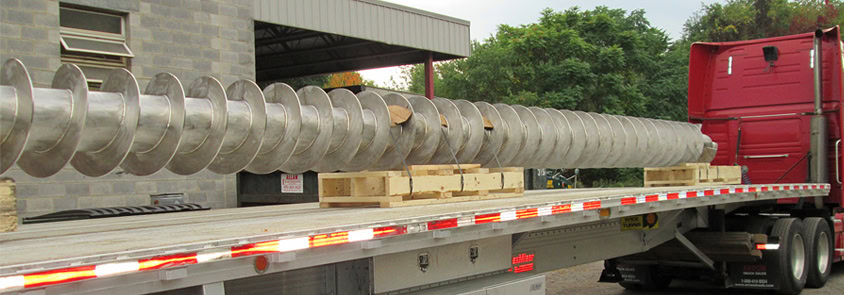
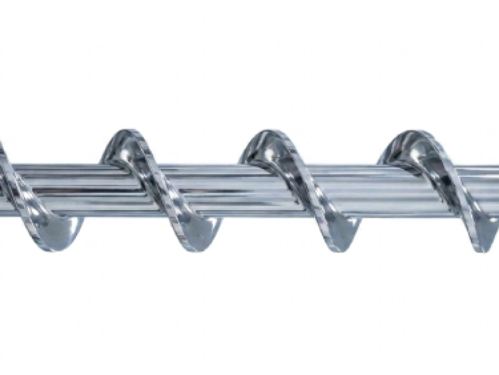
A short pitch feedscrew (or reduced pitch screw) is a specialized conveyor design where the distance between flights is significantly less than the diameter of the screw. While standard pitch screws are designed for general transport, short pitch screws are engineered for metering, precision feeding, and incline conveying. By compressing the material into smaller, more frequent pockets, this design provides superior control over material discharge and prevents “flooding” or uncontrolled surges.
Understanding Pitch Variations
To clarify the distinction, consider the following definitions:
- Standard Pitch Screw: The distance between flights is equal to the screw diameter (e.g., a 12″ diameter screw with a 12″ pitch). These are used for horizontal or slightly inclined transport.
- Short Pitch (Reduced Pitch) Screw: The distance between flights is typically 1/2 to 2/3 of the screw diameter. This creates a denser “plug” of material, which is essential for uniform feeding from bins or hoppers.
- Half Pitch Screw: A specific type of short pitch where the distance is exactly half the diameter. These are common in incline applications (over 20°) to prevent material from “fallback” or slipping back over the center pipe.
Key Design Considerations
- Material Head Load: Because short pitch screws are often located directly under hoppers, they must withstand the weight (head load) of the material above them. Drive torque must be sized accordingly.
- Volumetric Efficiency: A short pitch screw moves less volume per revolution than a standard pitch screw. To achieve the same throughput, the screw may need to run at a higher RPM.
- Incline Performance: As the angle of an incline increases, the efficiency of a standard pitch screw drops. Short pitch flights act as frequent “steps” to hold the material in place against gravity.
- Abrasive Wear: In short pitch designs, the material is in more frequent contact with the flighting surfaces. Using wear-resistant alloys or thicker sectional flights is crucial for longevity in harsh environments.
Typical Uses by Industry and Application
Short pitch feedscrews are selected when precise volumetric control or the ability to move material up steep grades is required. In essence, short pitch screws are employed whenever the conveyor acts as a meter rather than just a mover. Key applications include:
- Metering Ingredients: Precisely dosing grains, spices, or additives into a mixer or extruder to maintain recipe integrity.
- Hopper Discharge: Acting as a “feeder screw” under a large bulk bin to ensure a consistent flow of material without surging.
- Extruder Charging: Providing a steady, pulse-free stream of resin pellets or powders into downstream processing equipment
- Controlled Dosing: Handling fine, aerated powders that might otherwise “fluidize” and flow uncontrollably through a standard screw.
- Incline Conveying: Moving heavy materials like sand or cement up steep inclines where a standard pitch would allow the material to tumble backward.
- Dust Control: Compacting fine particles during transfer to reduce dusting at discharge points.
- Sludge and High-Moisture Feed: Providing the necessary “push” to move heavy, viscous materials through a system without the screw spinning inside the material.
Is it Sectional or Helicoid?
“Short pitch” refers to the geometric spacing of the flights, which can be achieved through either manufacturing method:
- Helicoid Flight: Cold-rolled into a continuous helix. Achieving a very tight short pitch in helicoid can sometimes be limited by the material’s ability to compress during rolling.
- Sectional Flight: Preferred for custom or heavy-duty short pitch applications. Because each segment is formed individually, James Eagen Sons Co. can achieve highly specific pitch-to-diameter ratios and thicknesses that helicoid rolling cannot match.
Comparison to Standard and Variable Pitch Screws
- Versus Standard Pitch: Standard pitch is more efficient for long-distance horizontal runs, but it lacks the “braking” action needed for metering. Short pitch is the go-to for discharge control.
- Versus Variable Pitch: In many feeder applications, a Variable Pitch screw is used. This design starts with a short pitch under the hopper (to pull material evenly from the back) and gradually increases to a longer pitch. This prevents material packing and reduces horsepower requirements.
Benefits of Working with James Eagen Sons Co.
- Deep Experience: Since 1875, we have mastered the nuances of volumetric feeding. We understand how different materials behave under pressure.
- Precision Manufacturing: Whether you need a 1/2 pitch, 2/3 pitch, or a custom variable pitch layout, our sectional flighting capabilities ensure the tightest tolerances.